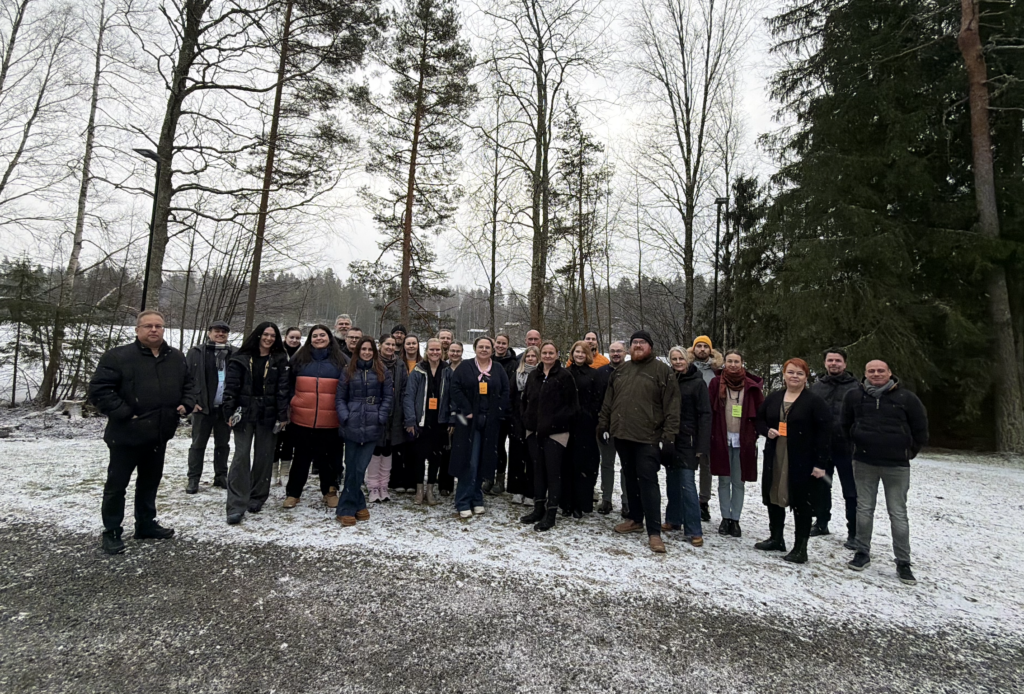
How can we strengthen farmers’ capacity to adopt smart cultivation technologies? What barriers stand in the way, and how can they be removed? These were the key questions explored during a two-day Innovation Camp attended by farmers, representatives from advisory organisations, experts from the agricultural sector, and natural resources students.
The winning idea came from the Matchmaking Team, which proposed a new field rental service. In this concept, underutilised Finnish fields would be rented out for efficient use, benefiting both landowners and tenants. At the heart of the solution is the idea of using a contracting service to consolidate scattered small field plots into professional cultivation. Dynamic pricing would be applied to maintain soil health and safeguard national food security.
Participants formed four teams, each examining the topic from a slightly different angle. How could peer learning be strengthened? How should support systems be developed to promote smart farming? What types of intelligent matchmaking solutions could help solve farm-level challenges? How can we identify farms already using smart technologies that could serve as examples for others? The perspectives were chosen on the basis of a pre-event survey, and participants were placed in teams according to their interests and expertise.
A Field Rental Service Leveraging the Opportunities of Smart Farming
“All the teams’ ideas were excellent and offer real potential for further development,” says Senior Researcher Gilbert Ludwig from JAMK University of Applied Sciences. “The main goal of TechCoach is to enhance farmers’ ability to assess, adopt and apply smart farming technologies on their farms. The Matchmaking Team’s field rental service supports this goal in many ways.”
“Finland has the world’s cleanest and safest conditions for cultivation thanks to strict legislation and monitoring. By branding our products as premium, we could attract foreign companies to rent fields and employ people in Finland. This would boost exports while preserving domestic know-how. Centralising work through contractors would also make it easier to invest in machinery using smart technologies, enabling wider adoption of precision farming,” the team explains.


“We arrived at this solution by examining the challenges faced by Finnish farms. Small farms struggle with continuity, producer prices are low, and food exports remain modest. At the same time, Finland produces the world’s safest food, and climate change is even increasing the variety of crops that can be grown here,” they add.
“Our aim is to connect global buyers seeking the cleanest possible food with the cleanest production conditions. Competing with mass production doesn’t make sense for Finnish products, instead, we should openly acknowledge that what we produce here is a luxury ingredient. By branding the service as such, domestic appreciation for these world-class raw materials could also increase.”
Smart Farming as a Criterion for Developing Agricultural Support Systems
An honourable mention was awarded to the team working on the development of support systems. They were praised for identifying legislative and policy challenges and for bravely tackling a complex topic while still producing a feasible idea.“ The idea is to influence policy programmes already during their preparation phase by offering a holistic solution,” says Project Manager Maria Suomela from ProAgria Central Union. “Despite the complexity and difficulty of the topic, the team developed a concept that can realistically be implemented.”
From Innovation Camp Outcomes to Future Action
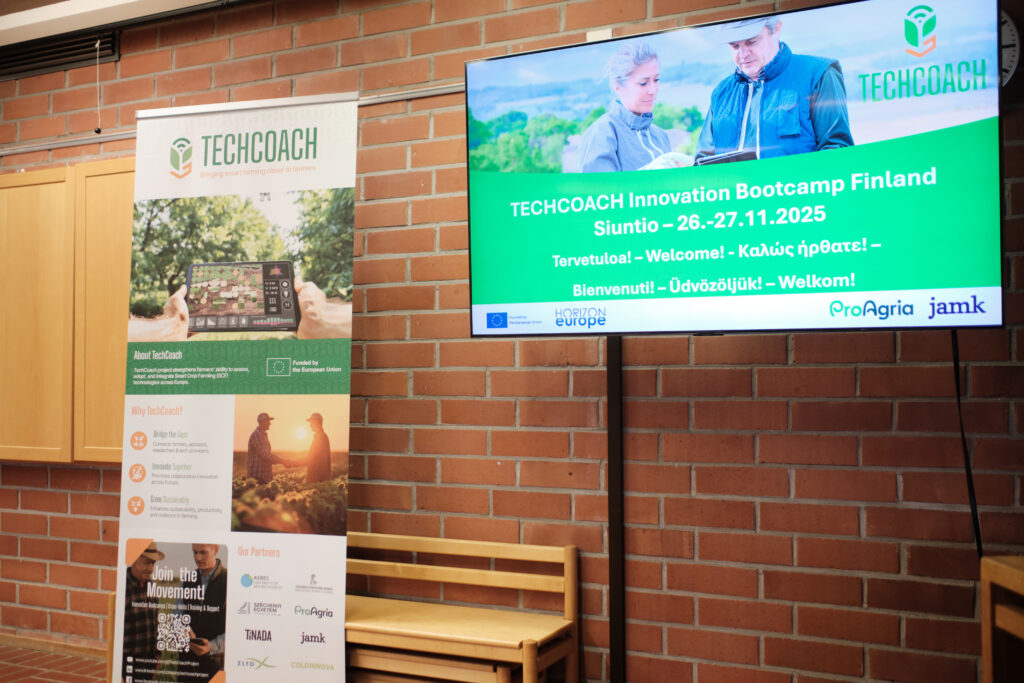
“We hope that the field rental service will be piloted, for example by a newly established startup,” the Matchmaking Team envisions.” Such a new operator would need technological skills, knowledge of primary production, and strong cultural and marketing expertise to ensure that Finnish food is truly perceived as a luxury product globally. Local insight and practical know-how would also be essential. This model therefore has room for both big-picture thinkers and hands-on professionals. It could also strengthen collaboration within Finland. Ultimately, it means producing luxury food grown in Finnish fields and enjoyed around the world.”The international TechCoach project promotes farmers’ capacity to adopt smart farming techniques. One of its key activities is the Innovation Camps, the first of which was held in Siuntio, Finland. Upcoming camps will take place in Hungary, the Netherlands, Italy and Greece. Their aim is to generate innovative ideas that accelerate the uptake of smart farming across Europe and to identify the factors that hinder progress.